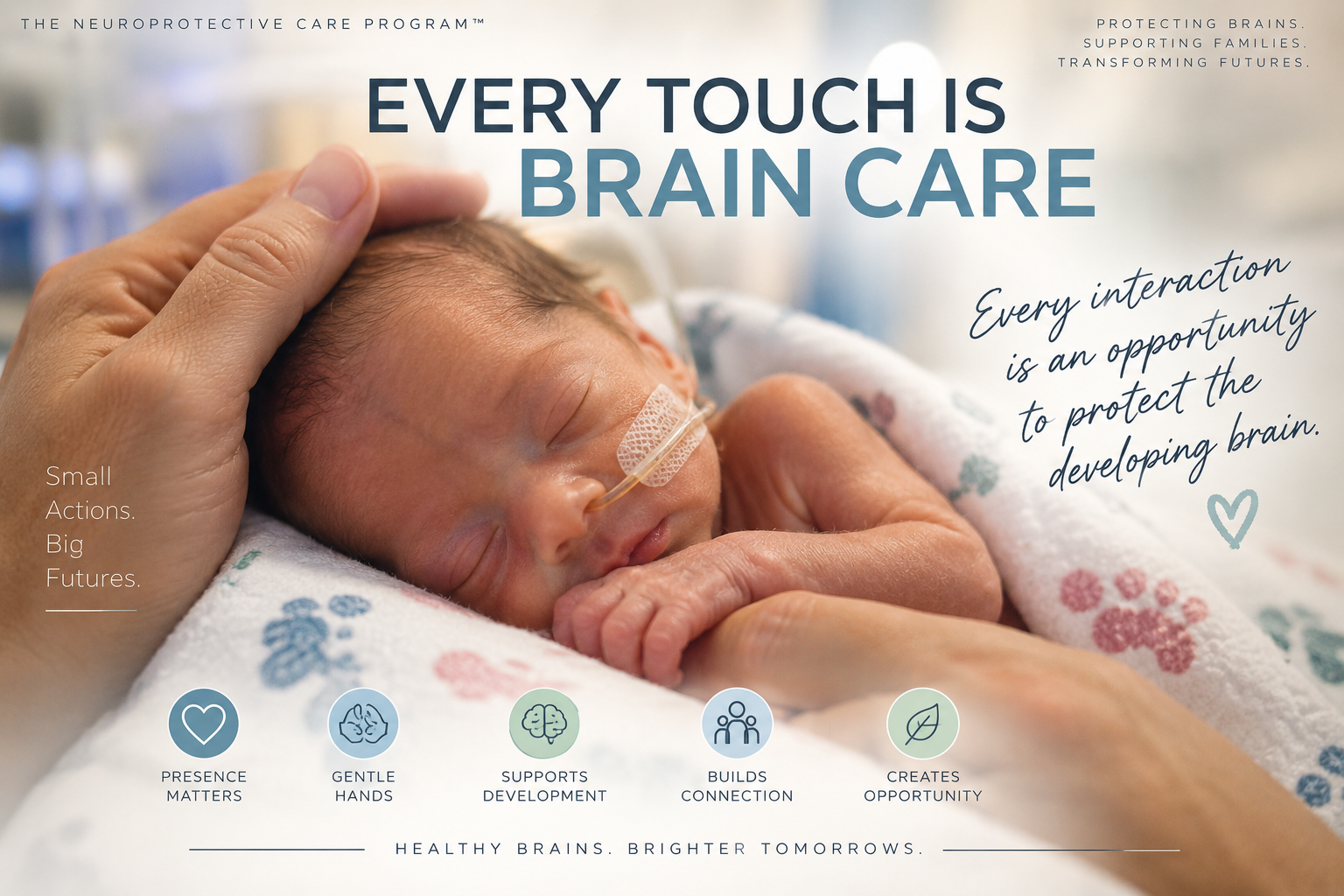
TOUCH & THE DEVELOPING NERVOUS SYSTEM
Touch is one of the earliest developing sensory systems. For the preterm or medically fragile infant, touch occurs while sensory, autonomic, motor, and stress-regulation systems are still developing. The infant may therefore experience and respond to touch differently depending on developmental maturity, physiologic stability, the type and intensity of touch, and what else is happening at the same time.
Touch is not experienced in isolation. Handling may occur alongside movement, sound, light, temperature change, pain, or changes in respiratory support. The developing nervous system must process these experiences while also working to maintain physiologic and behavioral stability.
The question is not simply whether we touch—but how, when, and in what context the infant experiences that touch.
NOT ALL TOUCH IS THE SAME
Touch can be comforting, organizing, stressful, painful, or overstimulating depending on the infant, the type of interaction, and the circumstances in which it occurs. A still supportive hand, containment, skin-to-skin contact, routine handling, repositioning, and a painful procedure are very different sensory experiences.
For an immature nervous system, the intensity, duration, predictability, and combination of sensory input can influence how well the infant is able to maintain organization and physiologic stability.
Neuroprotective care does not mean avoiding touch. It means making touch intentional, responsive, and developmentally appropriate.
TOUCH CAN CHANGE PHYSIOLOGY
For a preterm or medically fragile infant, handling and touch can be accompanied by measurable physiologic responses. Changes in heart rate, respiratory pattern, oxygen saturation, color, muscle tone, movement, and behavioral state may provide clues about how the infant is tolerating an interaction.
These responses are not simply numbers on a monitor. Together with behavioral cues, they can help caregivers recognize when an infant is maintaining stability, becoming stressed, or needs additional support and time to recover.
The infant’s response helps guide the next touch.
EXPERIENCE IS CUMULATIVE
An infant’s experience in the NICU is made up of thousands of interactions over time. A diaper change, repositioning, suctioning, feeding, examination, procedure, comforting hand, skin-to-skin experience, and period of protected sleep may each be brief, but together they form the infant’s developmental environment.
During a period of rapid brain development, repeated patterns of stress, sensory input, comfort, regulation, sleep, recovery, movement, and human connection become part of that ongoing experience.
This does not mean that a single stressful interaction determines an infant’s outcome. Rather, it reminds us to consider the pattern of experiences across hours, days, and weeks, and the opportunities we have to support stability and recovery throughout them.
The brain doesn’t experience care in isolation.
POSITIVE TOUCH IS PART OF DEVELOPMENT
Neuroprotective care is not only about reducing stress. Supportive sensory and relational experiences are also part of healthy development. Containment, a steady supportive hand, skin-to-skin care, comforting touch, and developmentally appropriate interaction can provide opportunities for regulation, connection, and positive sensory experience.
Parents and caregivers have a particularly important role. Familiar voice, scent, touch, and presence can become part of the infant’s developing experience of safety, comfort, and connection.
The goal is not a sensory-deprived environment. It is an environment in which experiences are intentional, developmentally appropriate, and responsive to the individual infant.
Protect the developing brain from unnecessary stress—and protect opportunities for positive experience.
RECOVERY IS PART OF THE EXPERIENCE
The infant’s response to care does not necessarily end when the caregiver’s hands move away. After handling, procedures, repositioning, feeding, or other stimulation, the infant may need time and support to return to physiologic and behavioral stability.
Recovery may be reflected in breathing, oxygenation, heart rate, muscle tone, movement, behavioral state, and the ability to settle. Protecting this period gives the infant an opportunity to reorganize before another demand is introduced.
Considering recovery changes the way we think about an interaction. The question is not only, “Did the baby tolerate the care?” but also, “How did the baby recover afterward?”
The touch may end. The infant’s response may continue.
THE INFANT DEFINES THE EXPERIENCE
There is no single type, amount, or pace of touch that is appropriate for every infant at every moment. Gestational age, medical condition, behavioral state, respiratory support, recent stress, sleep, pain, and previous caregiving experiences can all influence how an infant responds.
The same infant may also respond differently from one interaction to the next. What was well tolerated earlier may be difficult after a procedure, during illness, while sleeping, or when several demands occur close together.
Neuroprotective care therefore requires observation before, during, and after interaction. Physiologic and behavioral cues help caregivers individualize the timing, intensity, pacing, and support provided.
Developmental care begins with the infant in front of us—not simply the task in front of us.
HOW CARE IS DELIVERED MATTERS
Necessary care cannot always be delayed or made stress-free. Procedures, assessments, respiratory care, repositioning, and other interventions are essential parts of neonatal care. Neuroprotection does not change that reality—it changes how intentionally we approach the experience.
Preparing before touching, providing containment and postural support, coordinating movements, reducing competing sensory input when possible, pacing the interaction, and using additional hands when helpful can support the infant while necessary care is being provided.
When several caregivers are involved, coordinated touch and movement can also reduce unnecessary handling and create a more predictable experience for the infant.
The task may be necessary. The way we deliver it is still a choice.
WHAT HAPPENS BETWEEN CARE MATTERS
Neuroprotective care extends beyond periods of active handling. The time between interactions provides opportunities for sleep, physiologic regulation, recovery, growth, and integration of sensory experiences.
When possible, protecting these periods from unnecessary interruption allows the infant time to settle before another demand is introduced. This does not mean simply clustering as much care as possible into fewer encounters. For some infants, too many tasks within one caregiving period may itself become difficult to tolerate.
Instead, the timing and grouping of care should remain responsive to the infant’s condition, cues, developmental maturity, and ability to recover.
Sometimes the most neuroprotective touch is knowing when to wait before the next one.
PREDICTABILITY CAN SUPPORT ORGANIZATION
For the developing nervous system, care is not experienced as a checklist of separate tasks. Touch, movement, sound, position changes, and other sensory input may occur together and in rapid succession.
When appropriate, approaching the infant in a calm, organized sequence can provide opportunities to respond and adjust before additional sensory demands are introduced. A supportive hand before movement, a moment to settle after repositioning, or a brief pause between components of care can give the infant time to process what is happening.
Predictability does not mean that every interaction must follow the same routine. It means avoiding unnecessary abruptness and allowing the infant’s response to help determine what happens next.
Prepare. Support. Observe. Respond.
OUR HANDS BECOME PART OF THE ENVIRONMENT
For an infant receiving intensive care, human hands are part of the sensory environment. Hands assess, reposition, support, feed, comfort, perform procedures, provide respiratory care, and connect the infant with family and caregivers.
The infant cannot distinguish between disciplines, routines, or reasons for care. What the infant experiences is the combined pattern of touch, movement, sensory input, physiologic challenge, comfort, and recovery that occurs throughout the day.
Recognizing this encourages every member of the care team to consider not only what their hands need to accomplish, but what the infant may experience while they accomplish it.
Different hands. Different tasks. One developing nervous system experiencing them all.
TOUCH IS A TWO-WAY INTERACTION
Touch is not simply something a caregiver does to an infant. Each interaction provides information in both directions. The caregiver introduces touch, movement, support, or care—and the infant responds through physiologic and behavioral cues.
A change in breathing, movement, tone, facial expression, state, or ability to remain organized may signal that the infant is ready to continue, needs additional support, or needs time before the interaction progresses.
When caregivers notice these responses and modify their approach, care becomes responsive rather than task-driven. The infant’s cues become part of the clinical information guiding how the interaction unfolds.
We touch. The infant responds. We adjust.
EVERY INTERACTION BECOMES PART OF THE DEVELOPMENTAL ENVIRONMENT
No single interaction defines an infant’s developmental experience. Neuroprotective care is created through the pattern of care that surrounds the infant across the day—necessary procedures and handling, but also sleep, recovery, comfort, supportive touch, family connection, and opportunities for physiologic and behavioral stability.
This is why seemingly small decisions matter. How we approach the bedside, how we touch and move the infant, whether we notice a stress cue, whether we allow time to recover, and whether we protect periods of rest all contribute to the quality of that environment.
The goal is not perfect or stress-free care. It is thoughtful, responsive care that continually considers the developing infant while necessary medical care is provided.
Every interaction is one moment. Together, those moments become the infant’s experience of care.
EVERY TOUCH IS BRAIN CARE
Neuroprotective care does not require every interaction to be perfect. It asks us to recognize that care is being experienced by a developing infant—and to use that awareness to guide how we approach, touch, move, support, comfort, and respond.
Across disciplines, across shifts, and across the NICU journey, each caregiver contributes to the developmental environment surrounding the infant.
Every touch is an opportunity to observe.
Every response is information.
Every interaction is an opportunity to support the developing brain.
Every Touch Is Brain Care.