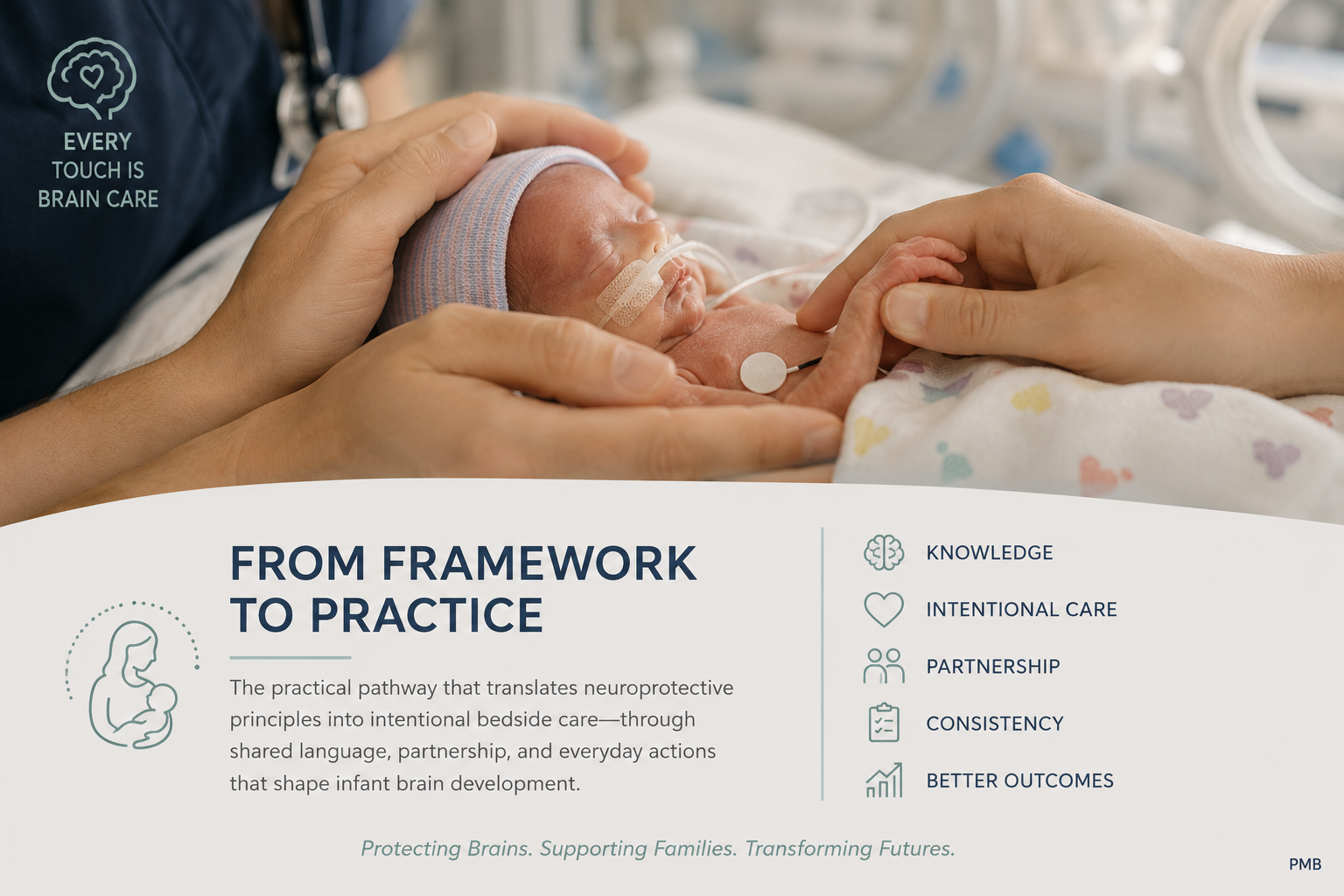
FROM FRAMEWORK TO PRACTICE
The Neuroprotective Care Program brings evidence, developmental principles, and everyday clinical practice together within a shared framework. The goal is not to add another task to the bedside. It is to bring neuroprotective thinking into the care that is already being provided.
Moving from framework to practice means understanding why an interaction matters, anticipating what the infant may need, observing the infant’s response, and adapting care accordingly.
SHARED LANGUAGE
Creates a common way for clinicians, disciplines, and families to communicate about neuroprotective care.
INTENTIONAL CARE
Encourages caregivers to consider the developing infant before, during, and after each interaction.
CONSISTENT PRACTICE
Supports neuroprotective principles across caregivers, disciplines, shifts, and the continuum of care.
IMPLEMENTING NEUROPROTECTIVE CARE
EDUCATION
Build shared understanding of neuroprotective principles and the developmental rationale behind care.
QUALITY IMPROVEMENT
Identify opportunities to strengthen consistency, reduce unnecessary variation, and integrate neuroprotective principles into existing care processes.
Moving neuroprotective care from knowledge into practice requires more than awareness. Sustainable change is supported when education, interdisciplinary collaboration, quality improvement, and evaluation work together to create a consistent approach to care.
Implementation can begin with small, practical changes—building shared understanding, identifying opportunities within existing care, and creating ways for teams to learn from both the infant’s response and their own practice.
COLLABORATION
Bring disciplines and families together around a shared approach to supporting the infant.
EVALUATION
Examine practice, infant responses, team experience, and relevant outcomes to guide learning and continued improvement.
FROM KNOWLEDGE TO BEDSIDE PRACTICE
Understanding neuroprotective principles is the beginning. The next step is translating that knowledge into the decisions, interactions, and responses that occur throughout everyday care.
Neuroprotective practice becomes meaningful when knowledge influences what we notice, how we prepare, what we do, and how we respond to the infant.
LEARN → PLAN → PRACTICE → PAUSE & RESPOND → PARTNER → EVALUATE
LEARN — UNDERSTAND THE WHY
Connect neuroprotective practices to the developing brain, physiologic stability, developmental needs, and the evidence supporting care.
PRACTICE — MAKE EVERY INTERACTION INTENTIONAL
Bring neuroprotective principles into routine care, procedures, positioning, feeding, handling, the environment, and family partnership.
PARTNER — SHARE THE CARE
Coordinate across disciplines and include families as meaningful participants in supporting comfort, regulation, development, and connection.
PLAN — ANTICIPATE BEFORE TOUCHING
Consider what care is needed, what can be coordinated, what support the infant may need, and whether another set of hands would help.
PAUSE & RESPOND — LET THE INFANT GUIDE THE PACE
Observe physiologic and behavioral cues during care. Adjust the pace, support, or approach when the infant’s response indicates a need.
EVALUATE — LEARN FROM PRACTICE
Reflect on the infant’s response, team practice, and relevant outcomes. Use what is learned to strengthen the next interaction and improve care over time.
BEFORE • DURING • AFTER CARE
Every interaction has a beginning, an experience, and a recovery. Neuroprotective care considers all three.
BEFORE CARE
Prepare • Observe • Coordinate • Protect
DURING CARE
Support • Observe • Pace • Respond
AFTER CARE
Restore • Reassess • Recover • Protect
What does this baby need from me right now?
BUILDING CONSISTENCY INTO CARE
Neuroprotective care becomes stronger when it is understood and supported across the entire care team. Consistency does not mean that every infant receives identical care. It means that caregivers share the same developmental priorities while adapting care to the individual infant.
Shared language, interdisciplinary communication, family participation, bedside teaching, and reflection can help carry neuroprotective principles across shifts, disciplines, and transitions in care.
Consistency is not sameness. It is a shared commitment to responsive, developmentally supportive care.
WHO THIS IS FOR
NICU CLINICIANS
Supports nurses, physicians, advanced practice providers, therapists, pharmacists, respiratory therapists, and others involved in neonatal care.
INTERDISCIPLINARY TEAMS
Creates a shared developmental framework that can support coordinated care across disciplines.
EDUCATORS & LEADERS
Provides a structure for orientation, staff education, practice development, and quality-improvement work.
FAMILIES & CAREGIVERS
Supports meaningful participation, cue recognition, comfort, connection, and continuity beyond the NICU.
HOW THE PROGRAM CAN BE USED
EDUCATION
Supports orientation, continuing education, staff development, and a shared understanding of neuroprotective care.
CLINICAL PRACTICE
Helps translate neuroprotective principles into everyday bedside decisions, interactions, and caregiving.
QUALITY IMPROVEMENT
Provides a framework for identifying opportunities, strengthening consistency, and supporting improvement initiatives.
PROGRAM DEVELOPMENT
Supports teams that are building, adapting, or sustaining neuroprotective practices within their own care environments.
FROM PRACTICE TO CONTINUOUS IMPROVEMENT
Neuroprotective care is not a one-time initiative. It develops through education, observation, collaboration, reflection, and continued evaluation of practice.
Teams can use the framework to identify strengths, recognize opportunities, support bedside consistency, and adapt implementation to the needs of their own infants, families, staff, and care environment.
Learn from the infant. Learn from the team. Let each experience strengthen the next.
BUILDING THE EVIDENCE
The individual practices represented within The Neuroprotective Care Program are informed by established and emerging neonatal evidence. The integrated program itself has not yet been prospectively evaluated as a complete intervention.
Future evaluation will begin by examining whether the program is understandable, feasible, acceptable, safe, equitable, and sustainable—and whether it contributes to measurable changes in bedside care and family experience.
As the program develops, increasingly rigorous evaluation can examine implementation, care processes, clinical outcomes, and longer-term neurodevelopmental outcomes.
The goal is to build the evidence carefully—measuring the parts before making claims about the whole.
CONTINUE EXPLORING THE PROGRAM
Explore the 11-Domain Framework, teaching language, evidence, and practical resources that support translation of neuroprotective principles into everyday care.